The Hidden Hour: How Much Is Lost Medical Equipment Really Costing Your Hospital?
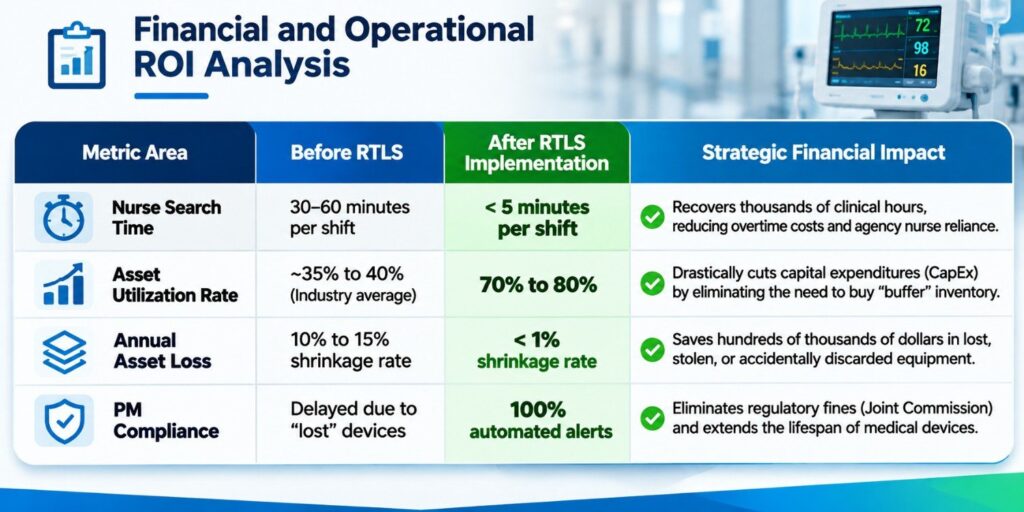
In a modern hospital, seconds save lives. Code blues require instant response, operating rooms run on rigid schedules, and patient care depends on absolute precision. Yet, beneath the high-tech facade of contemporary healthcare lies an archaic, highly inefficient reality: nurses and clinicians spend an average of 30 to 60 minutes per shift simply searching for medical equipment.
Imagine a registered nurse, tasked with managing a heavy patient load, walking from floor to floor, checking utility closets, and peering into empty patient rooms just to find a functioning infusion pump or a telemetry monitor. This isn’t a rare inconvenience; it is a daily systemic failure. Statistics show that one in three nurses spends over an hour per shift tracking down misplaced devices.
This hidden operational drain erodes clinical efficiency, burns out staff, compromises patient safety, and bleeds millions of dollars from hospital bottom lines. Fortunately, a proven technological remedy exists: Real-Time Location Systems (RTLS).
Below, we break down the hard industry data into a structured business case, demonstrating how transforming asset visibility from a guessing game into an automated science yields a massive return on investment (ROI).
Part 1: The Problem — The High Cost of the "Equipment Scavenger Hunt"
The time clinicians spend hunting for assets is a symptom of a larger logistical breakdown. Without centralized visibility, devices pool in unauthorized areas, get hoarded, or leave the facility.
2000+ Man-hours
Wasted each year in a 200-bed hospital
$14 Billion
In lost clinical time nationally in the US (Annually).
13%
Of doctor's shifts spent searching for equipment, charts and paper work
77%
Of hospital leaders agree clinical staff waste too much time searching for items
When 77% of hospital leaders openly agree that clinical staff waste too much time searching for items, it is no longer an “inconvenience”—it is a strategic crisis demanding an enterprise solution.
Part 2: The Business Case for RTLS Implementation
To solve this crisis, forward-thinking healthcare organizations are building business cases around Real-Time Location Systems (RTLS). RTLS acts as an indoor GPS, utilizing active or passive tags (via Wi-Fi, Bluetooth Low Energy, or Infrared) attached to equipment to feed real-time coordinates into a centralized dashboard.
Here is how the quantitative data translates into a formal Executive Business Case for RTLS Investment.
Executive Summary
Objective: Implement an enterprise-wide RTLS network to automate asset tracking, recover clinical hours, reduce equipment hoarding, and optimize capital expenditures.
Target Metric: Reduce equipment search times by 80%, recovering up to 50 minutes per nurse per shift.
Detailed Financial Breakdown
1. Recovered Labor Productivity
A 300-bed hospital with 500 nurses loses 375 hours daily (45 minutes per nurse). At $45/hour, that's $16,875 per day or roughly $6.1 million annually. RTLS recaptures over 90% of this time.
2. Capital Expenditure (CapEx) Right-Sizing
Lack of visibility leads to hoarding and 20% to 30% over-procurement. RTLS tracks actual utilization (e.g., pumps active only 40% of the time), enabling executives to freeze unnecessary purchases and save millions in procurement costs.
3. Regulatory Compliance and Preventative Maintenance (PM)
Biomedical engineers must perform periodic maintenance on life-support equipment. RTLS instantly locates devices flagged for service, keeping the hospital audit-ready 365 days a year and avoiding accreditation penalties.
Part 3: The Intangibles — Morale, Safety, and Patient Experience
Higher Staff Morale
Eliminates daily frustration, improves job satisfaction, and supports staff retention in an era of healthcare burnout.
Improved Patient Safety & Experience
Faster access to critical equipment, quicker therapy initiation, shorter discharge times, higher ED throughput, and better HCAHPS (patient satisfaction) scores.
Conclusion:
The numbers do not lie. Spending an hour a shift hunting for the tools of survival is a luxury modern healthcare budgets cannot afford. Transitioning to an RTLS solution shifts a hospital from a reactive, chaotic environment to a proactive, data-driven facility.
By approving the investment in RTLS, executive leadership isn’t just buying tags and software; they are buying back clinical time, restoring staff sanity, and protecting the bottom line. It is time to stop searching and start healing.
Dinesh Mehn is the Founder and CEO of DigitoWork, specializing in IT Asset Management, IT Security, and cost optimization. A Certified Master Black Belt and former GE professional, he assists IT teams in enhancing efficiency and security. DigitoWork has been awarded the prestigious ISO 17025 certification for its IT Security Testing Lab, becoming the FIRST company in Telangana to achieve this milestone. This recognition reinforces DigitoWork's commitment to delivering IT Security Testing, Vulnerability Assessment & Penetration Testing (VAPT), Ethical Hacking, Red Team, Exploitation Testing solutions to organizations that need to improve Application Security Posture.