

PEN Test Request PEN Test
Funding Ready PEN Test for Founders @ ISO 17025 Accredited Security Testing Lab – Click Here

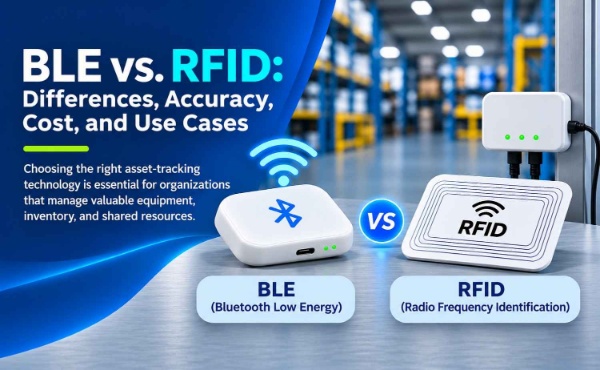
BLE vs. RFID: A Complete Guide to Differences, Use Cases, Accuracy, Cost, and Limitations

What is BLE (Bluetooth Low Energy)?

A low -power wireless technology that transmits small amounts of data to help identify and locate assets indoors. 

What is RFID (Radio Frequency Identification)?

A wireless technology that uses radio waves to identify objects through electronic tags and readers.

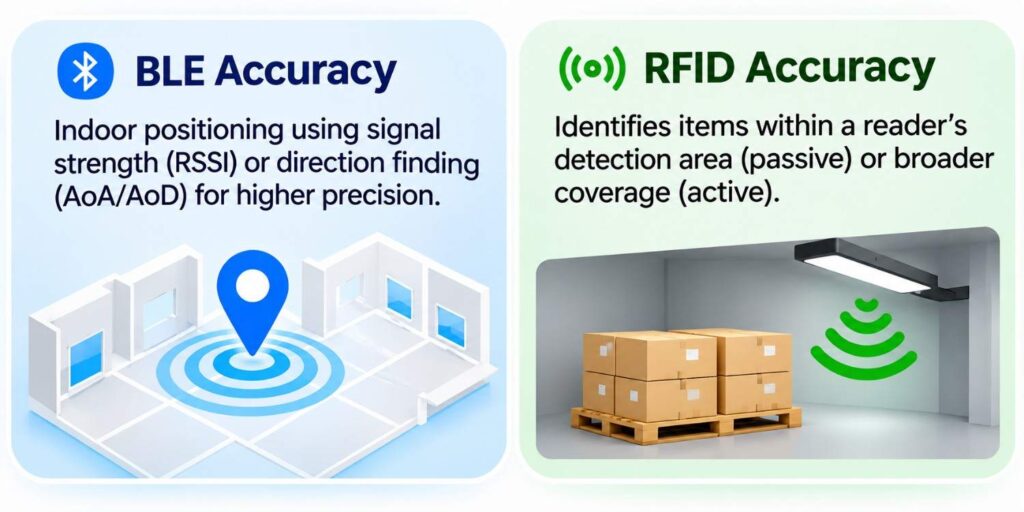
BLE and RFID Accuracy
Comparison
BLE
Passive RFID
Active RFID
Technology
Bluetooth Low Energy
Radio Frequency Identification
Power Source
Battery-powered
Powered by reader signal
Battery-powered
Communication
Broadcasts signals
Responds to reader
Transmits signals
Primary Purpose
Location visibility
Item identification
Longer-range identification and monitoring
Location Capability
Indoor positioning and proximity
Reader detection points
Zone-based tracking
Battery Maintenance
Required
Not required
Required

BLE vs. RFID: Cost Comparison

Cost Factor
BLE
Passive RFID
Active RFID
Tag Cost
Low to moderate
Very low
Moderate to high
Infrastructure
Receivers and gateways
Readers and antennas
Compatible readers
Battery Replacement
Yes
No
Yes
Best Cost Fit
Mobile asset visibility
Large-scale inventory
Selected longer-range monitoring

Real-World Applications Across Industries

Hospital Asset Tracking Corridor

Healthcare

Locate medical equipment and support inventory and asset audits.

digitowork_manufacturing_asset_tracking

Manufacturing

Track tools and equipment and support production checkpoints.

digitowork_university_asset_tracking

Universities

Universities shared laptops, projectors, and lab equipment & manage inventory.

digitowork_it_asset_tracking

IT Asset Mgt

Locate IT devices and support asset identification and audits.

Frequently Asked Questions (FAQs)

BLE (Bluetooth Low Energy) uses wireless signals to support indoor positioning and ongoing asset visibility. RFID (Radio Frequency Identification) uses radio waves and readers to identify tagged items, commonly for inventory management and checkpoint-based tracking.

It depends on your tracking requirements. BLE is generally more suitable for locating mobile assets across indoor environments, while RFID is often preferred for identifying large quantities of items and conducting inventory checks.

BLE can provide indoor positioning using receiver networks and methods such as RSSI, Angle of Arrival (AoA), and Angle of Departure (AoD). Passive RFID typically identifies an asset within a reader's detection area rather than providing continuous location coordinates. Actual performance depends on the system configuration and environment.

Passive RFID tags do not contain an internal battery. They receive energy from an RFID reader to communicate their identification information. Active RFID tags contain batteries and transmit their own signals, supporting longer-range detection and selected tracking applications.

Passive RFID tags are generally less expensive than battery-powered BLE tags. However, the total cost depends on readers, receivers, gateways, installation, software, maintenance, and the level of tracking accuracy required.

Author

  • Dinesh

    Dinesh Mehn is the Founder and CEO of DigitoWork, specializing in IT Asset Management, IT Security, and cost optimization. A Certified Master Black Belt and former GE professional, he assists IT teams in enhancing efficiency and security.  DigitoWork has been awarded the prestigious ISO 17025 certification for its IT Security Testing Lab, becoming the FIRST company in Telangana to achieve this milestone.  This recognition reinforces DigitoWork's commitment to delivering IT Security Testing, Vulnerability Assessment & Penetration Testing (VAPT), Ethical Hacking, Red Team, Exploitation Testing solutions to organizations that need to improve Application Security Posture.