10 Signs Your Fixed Asset Management Is Hurting EBITDA and CAPEX
Fixed assets are often treated as an accounting responsibility. But poor fixed asset management can affect much more than the balance sheet.
When organizations cannot accurately track what they own, where assets are located, how they are being used, or when they were retired, they can face unnecessary CAPEX, excess operating costs, inaccurate asset records, and audit risks.
The problem usually comes from small gaps across the asset lifecycle—an asset is purchased but not recorded correctly, transferred without updating its location, left idle, or retired without updating financial records.
1. You Don’t Have One Reliable Asset Register
If Finance, Operations, Procurement, Engineering, and Facilities report different asset numbers, your organization lacks a reliable fixed asset register.
Management should be able to answer three basic questions:
What assets do we own?
Where are they?
Are they being used productively?
Without reliable asset data, CAPEX planning, depreciation, maintenance budgets, insurance, and replacement decisions become more difficult.
2. Asset Reports Take Days to Prepare
If producing an asset report requires searching through spreadsheets, ERP systems, maintenance records, and departmental files, your asset data is probably fragmented.
Reliable asset management systems should make important information available when Finance or management needs it—not days later.
This is particularly important for:
Audits
Budgeting
CAPEX planning
Insurance
Board reporting
M&A due diligence Pasted text
3. Asset Data Is Scattered Across Departments
Procurement knows what was purchased. Finance knows what was capitalized. Operations knows what is being used. Engineering knows what is being maintained.
But if these records are not connected, assets can fall between departments.
This can lead to:
Duplicate purchases
Incorrect capitalization
Unrecorded transfers
Missed disposals
Excess maintenance costs
Inaccurate asset values
4. Physical Asset Verification Is Irregular
A fixed asset register is only useful when it reflects physical reality.
Assets may be missing, obsolete, damaged, idle, transferred, or already disposed of while remaining on the register. Pasted text
This improves asset register accuracy and supports stronger financial controls.
5. You Buy New Assets Because Existing Ones Cannot Be Found
Poor asset visibility can lead directly to unnecessary CAPEX.
A department may request a new machine, vehicle, laptop, tool, or other equipment simply because nobody knows whether an existing asset is available elsewhere.
Before purchasing, organizations should ask: Can we reuse, redeploy, or refurbish an existing asset?
A better approach is: Reuse → Redeploy → Refurbish → Buy New Improving asset visibility can support better CAPEX management and capital efficiency.
6. Idle Assets Are Still Costing Your Business
An asset does not have to be missing to create financial leakage.
Idle or underutilized assets can continue generating costs through depreciation, maintenance, insurance, storage, utilities, and support. Pasted text That makes asset utilization a critical part of effective fixed asset management.
7. Your Fixed Asset Register Does Not Match Physical Assets
When the fixed asset register does not match physical assets, it can indicate missing equipment, duplicate records, incorrect transfers, unrecorded disposals, or capitalization errors. Pasted text
A strong asset lifecycle management process should connect:
Asset leakage can continue even after an asset is no longer productive. Organizations may still incur costs for:
Maintenance
Calibration
Insurance
Leasing
Service contracts
Extended warranties
Vendor support
Rentals
9. Asset Retirement and Disposal Are Not Properly Controlled
Many organizations have strong purchasing controls but weaker asset retirement and disposal management. An asset may be physically disposed of while remaining on the books, or financially written off while still appearing on maintenance or insurance contracts. Pasted text
This may be one of the biggest warning signs. Finance manages capitalization. Procurement manages purchasing. Operations manages utilization. Engineering manages maintenance. Facilities manages location.
But who owns the complete asset lifecycle? Effective asset lifecycle management should connect every stage:
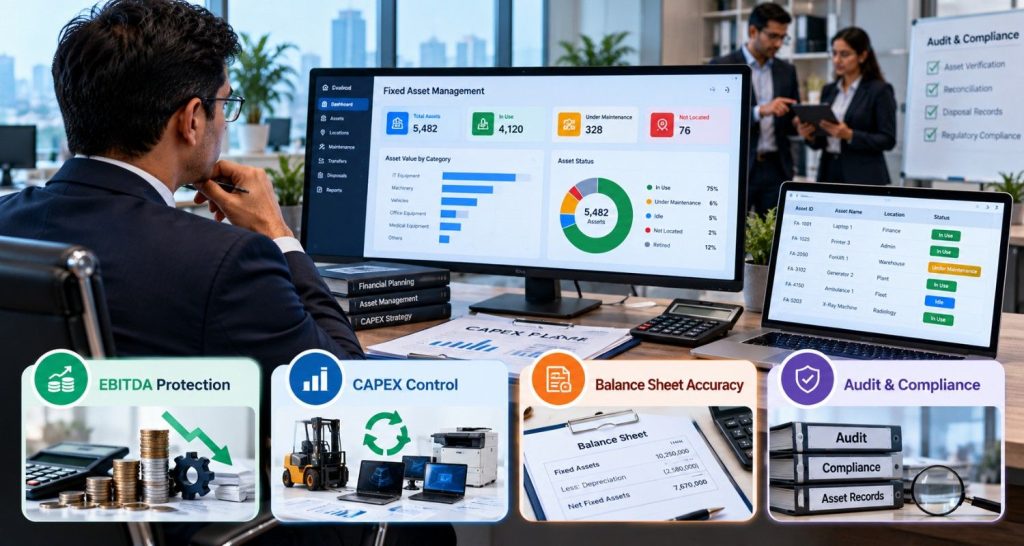
EBITDA Protection Reduce unnecessary maintenance, insurance, support, leasing, and service costs.
CAPEX Control Reuse and redeploy existing assets before investing in new ones.
Balance Sheet Accuracy Maintain accurate asset values, depreciation, and financial records.
Audit & Compliance Accurate records and regular verification support audit readiness.
Conclusion
Fixed asset leakage rarely comes from a single major issue. It builds quietly through small gaps—an idle asset, an outdated location, an unrecorded transfer, an unnecessary purchase, an inactive maintenance contract, or a disposal that was never updated in Finance.
Strong fixed asset management helps organizations maintain accurate asset records, improve visibility, control CAPEX, reduce unnecessary costs, and strengthen asset lifecycle governance. By connecting physical assets with financial and operational data, organizations can protect capital, improve accountability, and make better investment decisions.
Dinesh Mehn is the Founder and CEO of DigitoWork, specializing in IT Asset Management, IT Security, and cost optimization. A Certified Master Black Belt and former GE professional, he assists IT teams in enhancing efficiency and security. DigitoWork has been awarded the prestigious ISO 17025 certification for its IT Security Testing Lab, becoming the FIRST company in Telangana to achieve this milestone. This recognition reinforces DigitoWork's commitment to delivering IT Security Testing, Vulnerability Assessment & Penetration Testing (VAPT), Ethical Hacking, Red Team, Exploitation Testing solutions to organizations that need to improve Application Security Posture.