Hospital Equipment Tracking: How to Reduce Search Time and Improve Healthcare Operations?
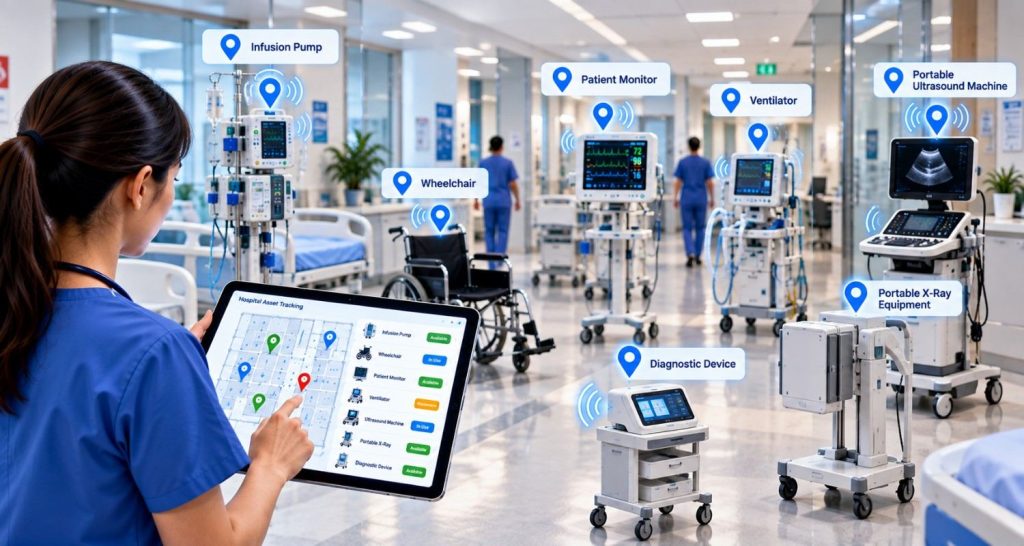
Hospitals depend on medical equipment every day. From infusion pumps and wheelchairs to ventilators, patient monitors, and portable diagnostic devices, these assets move constantly between departments.
The challenge is simple: when equipment cannot be found quickly, hospital staff lose valuable time.
Manual registers, spreadsheets, and disconnected records can make it difficult to know where equipment is, who is using it, whether it is available, or when it needs maintenance. Your original content highlights this visibility problem and its impact on healthcare operations.
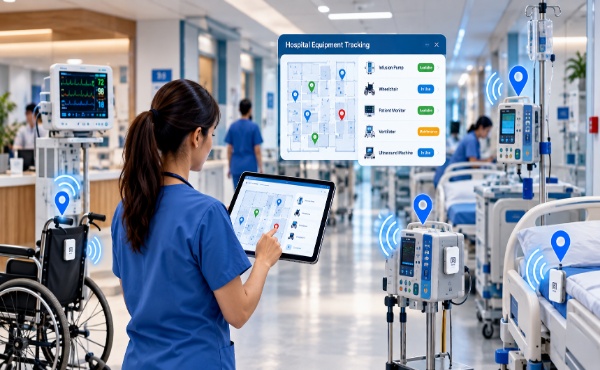
A modern hospital equipment tracking system helps healthcare organizations create better visibility across their medical assets and make equipment easier to locate, manage, maintain, and utilize.
What Is Hospital Equipment Tracking?
Hospital equipment tracking is the process of identifying, locating, monitoring, and managing medical equipment across hospitals and healthcare facilities.
A tracking solution can use technologies such as RFID, barcode, BLE, Wi-Fi, or RTLS, depending on the required accuracy, coverage, and workflow.
With centralized tracking, healthcare teams can quickly understand:
Where is the equipment?
Is it available?
Which department has it?
When was it last serviced?
Is maintenance due?
How frequently is it being used?
Why Is Hospital Equipment Tracking Important?
Medical equipment rarely stays in one place. Infusion pumps, wheelchairs, patient monitors, ventilators, and portable diagnostic devices move between wards, ICUs, emergency departments, operating rooms, and storage areas. Your source specifically identifies these mobile assets as frequent tracking challenges.
Without accurate visibility, hospitals can experience:
Longer equipment search times
Delayed procedures
Underutilized equipment
Unnecessary equipment purchases
Missed maintenance
Equipment loss or misplacement
Higher rental costs
Incomplete asset records
1. Find Medical Equipment Faster
One of the biggest benefits of medical equipment tracking is helping staff locate equipment when they need it. Instead of calling different departments or walking through multiple areas, authorized users can check the equipment’s location through a centralized dashboard.
This can be especially useful for:
Infusion pumps
Wheelchairs
Patient monitors
Ventilators
Portable ultrasound machines
Portable X-ray equipment
Diagnostic devices
2. Improve Hospital Equipment Utilization
Hospitals may have equipment available somewhere in the facility while another department believes it is unavailable.
Hospital asset tracking provides better visibility into equipment location and usage. Teams can identify assets that are heavily used, idle, or underutilized and redistribute them when required.
Better utilization can help hospitals make more informed decisions about purchasing, renting, and allocating medical equipment.
3. Reduce Lost and Misplaced Equipment
Mobile equipment can easily move outside its expected department or storage area.
With hospital equipment tracking, organizations can monitor asset movement and, where supported by the technology, configure alerts for equipment leaving designated areas.
This improves accountability and makes it easier for teams to locate misplaced assets.
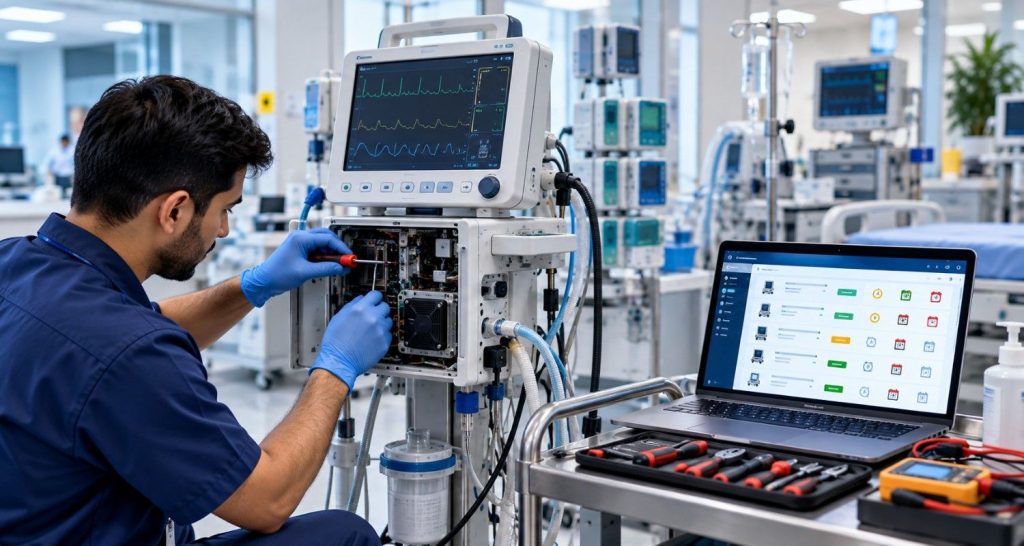
4. Improve Medical Equipment Maintenance
Medical devices also require regular:
Preventive maintenance
Calibration
Inspection
Repairs
Service
Warranty management
Connecting equipment records with maintenance information allows biomedical and engineering teams to see service history and upcoming maintenance requirements from one place.
5. Simplify Hospital Asset Audits
Traditional asset audits can require employees to physically locate equipment, verify asset numbers, and update spreadsheets.
A centralized hospital asset management system can maintain structured records for equipment across departments and locations.
Depending on the tracking technology, RFID, barcode, QR, BLE, or RTLS can support different inventory and verification workflows.
Conclusion
Hospital equipment should be easy to find, manage, maintain, and monitor.
A modern hospital equipment tracking system gives healthcare organizations better visibility into medical equipment and helps teams manage assets throughout their lifecycle.
Whether using RFID, QR codes, barcode, BLE, or RTLS, the objective is the same: know what equipment you have, where it is, how it is being used, and when it needs attention.
By improving hospital asset tracking and medical equipment management, healthcare organizations can reduce unnecessary searching, improve equipment utilization, support maintenance teams, and make better operational decisions.
Dinesh Mehn is the Founder and CEO of DigitoWork, specializing in IT Asset Management, IT Security, and cost optimization. A Certified Master Black Belt and former GE professional, he assists IT teams in enhancing efficiency and security. DigitoWork has been awarded the prestigious ISO 17025 certification for its IT Security Testing Lab, becoming the FIRST company in Telangana to achieve this milestone. This recognition reinforces DigitoWork's commitment to delivering IT Security Testing, Vulnerability Assessment & Penetration Testing (VAPT), Ethical Hacking, Red Team, Exploitation Testing solutions to organizations that need to improve Application Security Posture.
Thank you for registering for the webinar. The link to the webinar is sent to the email id provided.