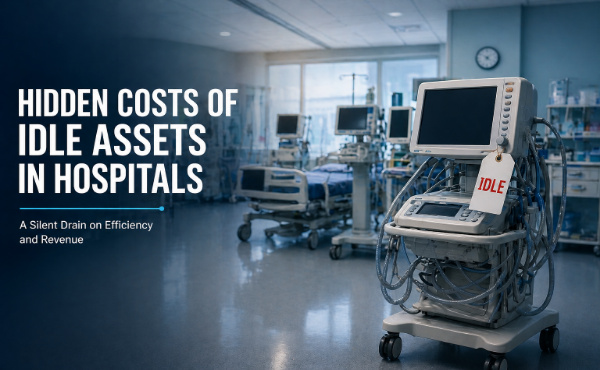
Hidden Costs of Idle Assets in Hospitals: A Silent Drain on Healthcare Efficiency
Hospitals invest heavily in medical equipment to ensure quality patient care. However, a significant portion of these assets often remains idle, underutilized, or improperly managed, leading to hidden financial and operational losses.
Idle assets in hospitals are more than just unused equipment—they represent lost revenue, increased maintenance costs, compliance risks, and inefficiencies that directly impact patient care and hospital profitability.
What Are Idle Assets in Hospitals?
Idle assets refer to medical equipment or infrastructure that is:
Not actively used
Underutilized
Misplaced or unavailable when needed
Kept without proper tracking or maintenance
Common examples include:
Diagnostic machines (MRI, CT scans)
ICU equipment
Wheelchairs and stretchers
Surgical instruments
The Hidden Costs of Idle Medical Equipment
1. Financial Loss Due to Underutilization
Medical equipment requires significant investment. When assets sit idle:
ROI decreases drastically
Hospitals lose potential revenue from patient services
Capital is locked in unused resources
2. Increased Maintenance & Lifecycle Costs
Even unused equipment requires:
Regular servicing
Calibration
Compliance checks
3. Delayed Patient Care
When assets are not properly tracked:
Equipment may not be available when needed
Staff waste time searching for devices
Emergency response is slowed
4. Compliance & Audit Risks
Healthcare facilities must comply with strict regulations:
Understanding the root causes helps in solving the issue:
Lack of real-time asset tracking
Poor inventory management
Over-purchasing due to inaccurate demand forecasting
Inefficient inter-department coordination
Manual tracking systems
How to Reduce Idle Assets in Hospitals?
1. Implement an Asset Management System
Track equipment in real time
Monitor usage patterns
Optimize asset allocation
2. Use IOT & Smart Tracking Technologies
RFID
Barcode systems
IoT sensors
3. Data-Driven Decision Making
Equipment usage reports
Downtime metrics
Departmental demand
4. Centralized Asset Allocation
Avoid duplication
Improve availability
Increase efficiency
5. Regular Audits & Optimization
Asset audits
Performance checks
Lifecycle assessments
Conclusion
Idle assets in hospitals are a hidden but significant challenge. By adopting modern asset management solutions, smart tracking technologies, and data-driven strategies, healthcare organizations can transform inefficiencies into measurable gains.
Reducing idle assets is not just about cost savings—it’s about enhancing patient care, improving operational efficiency, and building a future-ready healthcare system.
Dinesh Mehn is the Founder and CEO of DigitoWork, specializing in IT Asset Management, IT Security, and cost optimization. A Certified Master Black Belt and former GE professional, he assists IT teams in enhancing efficiency and security. DigitoWork has been awarded the prestigious ISO 17025 certification for its IT Security Testing Lab, becoming the FIRST company in Telangana to achieve this milestone. This recognition reinforces DigitoWork's commitment to delivering IT Security Testing, Vulnerability Assessment & Penetration Testing (VAPT), Ethical Hacking, Red Team, Exploitation Testing solutions to organizations that need to improve Application Security Posture.