Navigating the Storm: How CVSS and CVE Illuminate the Path Through Zero-Day Vulnerabilities
The Shadow of the Unknown In the ever-evolving landscape of cybersecurity, few terms strike more fear into security teams than “zero-day vulnerability.” These hidden flaws in software, unknown to vendors and defenders until exploited, represent the ultimate asymmetric threat. Yet, in this seemingly chaotic environment, structured frameworks provide critical navigation tools. Two of the most important are the Common Vulnerabilities and Exposures (CVE) system and the Common Vulnerability Scoring System (CVSS). Together, they transform obscure threats into quantifiable risks, enabling decisive action even when time is desperately short.
The Fundamentals – CVE and CVSS Demystified
The Dictionary of Vulnerabilities: CVE The Common Vulnerabilities and Exposures (CVE®) system is a publicly available dictionary of known cybersecurity vulnerabilities. Managed by MITRE Corporation, it provides a standardized identifier—a CVE ID—for each vulnerability.
How It Works:
Each entry includes an identification number (e.g., CVE-2021-44228 for Log4Shell), a description, and references.
The system ensures everyone references the same vulnerability with the same name, eliminating confusion.
CVE doesn’t assess severity; it merely catalogs and identifies.
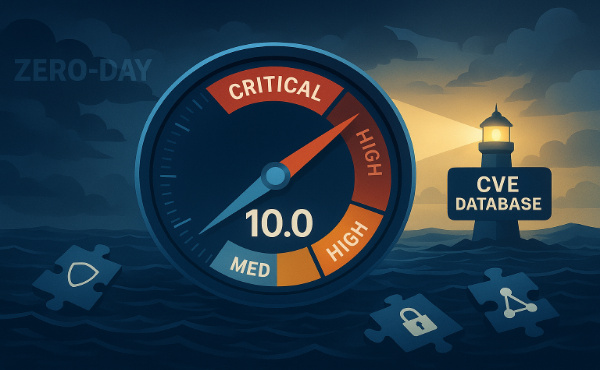
The Measuring Stick: CVSS The Common Vulnerability Scoring System (CVSS) is an open framework for communicating the characteristics and severity of software vulnerabilities. It provides numerical scores (0-10) representing severity, translated into qualitative ratings: Low (0.0-3.9), Medium (4.0-6.9), High (7.0-8.9), and Critical (9.0-10.0).
The Three Metric Groups:
Base Score Metrics– Intrinsic characteristics that don’t change (Exploitability & Impact).
Temporal Score Metrics– Characteristics that evolve over time (Exploit Code Maturity, Remediation Level, Report Confidence).
Environmental Score Metrics– Organization-specific characteristics (Security Requirements and Modified Base Metrics).
Calculation Example: A vulnerability exploitable over the network (AV:N) with low attack complexity (AC:L), requiring no privileges (PR:N) or user interaction (UI:N), that causes total loss of confidentiality, integrity, and availability (C:H, I:H, A:H) receives a base score of 10.0 (Critical). This indicates an immediately exploitable vulnerability with catastrophic consequences.
The Intersection – CVE and CVSS in Action
How They Work Together CVE provides the “what”—a standardized identifier. CVSS provides the “so what”—how severe it is and why. When a zero-day emerges, the security community races to:
Identify and catalog it with a CVE ID.
Analyze and score it using CVSS.
Communicate consistently using both frameworks.
The Lifecycle of a Zero-Day
Day 0: Discovery and Exploitation: Attackers exploit; defenders operate blind.
Day 1: Recognition and Cataloging: Vulnerability identified; CVE ID assigned.
Day 2-3: Scoring and Prioritization: CVSS Base Score calculated; Temporal & Environmental metrics applied.
Day 4+: Response and Mitigation: Patches released; scores guide patching priorities.
Case Studies – Zero-Days Tamed by Frameworks
Case Study 1: Log4Shell (CVE-2021-44228) The Zero-Day: Critical vulnerability in Apache Log4j allowing remote code execution (Dec 2021). CVSS Analysis: Base Score: 10.0 (Critical). Exploit quickly became widely available. Impact: The clear 10.0 score mandated an immediate, all-hands response, justifying emergency procedures and resource allocation, leading to a coordinated global mitigation effort.
Case Study 2: Proxy Logon (CVE-2021-26855) The Zero-Day: Chain of vulnerabilities in Microsoft Exchange Server (Mar 2021). CVSS Analysis: Base Score: 9.8 (Critical). Environmental metrics showed on-premises servers at higher risk than cloud. Impact: High CVSS score combined with environmental context allowed organizations to prioritize patching for truly exposed systems, enabling efficient crisis resource allocation.
Case Study 3: Heartbleed (CVE-2014-0160) The Zero-Day: Catastrophic information disclosure vulnerability in OpenSSL. CVSS Analysis (v3.1): Base Score: 7.5 (High), not Critical, due to the complexity of achieving full system compromise. Lesson: Highlights that CVSS scores can mismatch public perception; underscores the need to understand metrics and consider business context beyond the score alone.
Strategic Decision-Making & Building a Response Framework
Beyond the Base Score
Temporal Metrics: Track evolving factors like Exploit Code Maturity (E) and Remediation Level (RL).
Environmental Customization: Pre-define Security Requirements for Confidentiality (CR), Integrity (IR), Availability (AR) and adjust Modified Base Metrics for your systems.
Create decision trees for different CVSS score ranges.
Build communication templates for various severity levels.
Configure tools to properly ingest and display CVSS data.
During a Zero-Day Event:
Immediate Actions:Find CVE ID and CVSS score, apply environmental modifiers, activate response team.
Ongoing Management:Monitor for Temporal updates, adjust response as patches emerge, document decisions linked to CVSS rationale.
Conclusion: Illuminating the Darkness
Zero-day vulnerabilities will always represent a special category of threat. In this turbulent environment, CVE and CVSS serve as essential navigation instruments. CVE provides the common language to understand what we face. CVSS provides the measurement system to determine how bad it is and what to do about it.
The most mature security organizations actively integrate these frameworks into decision processes, customize them with context, and use them to communicate across technical and business boundaries. When the next critical zero-day emerges, your preparation with these frameworks will determine whether you’re making decisions in darkness or navigating with clarity. With CVE as your map and CVSS as your compass, you can chart a course through even the most treacherous zero-day seas.
Krishna Prasad is the Quality Manager at NABL IT Security’s ISO 17025-certified Security Testing Lab. He ensures that all security testing processes adhere to the highest quality standards and comply with global security regulations. With extensive experience in quality assurance, Krishna oversees the implementation of rigorous testing methodologies, guaranteeing that security assessments are both accurate and reliable.
Additionally, he manages asset tracking within the lab, ensuring that all security assets are effectively maintained, optimized, and up-to-date to support high-quality testing services. His dedication to quality and precision helps organizations enhance their security posture and meet compliance requirements in an increasingly complex cybersecurity landscape.