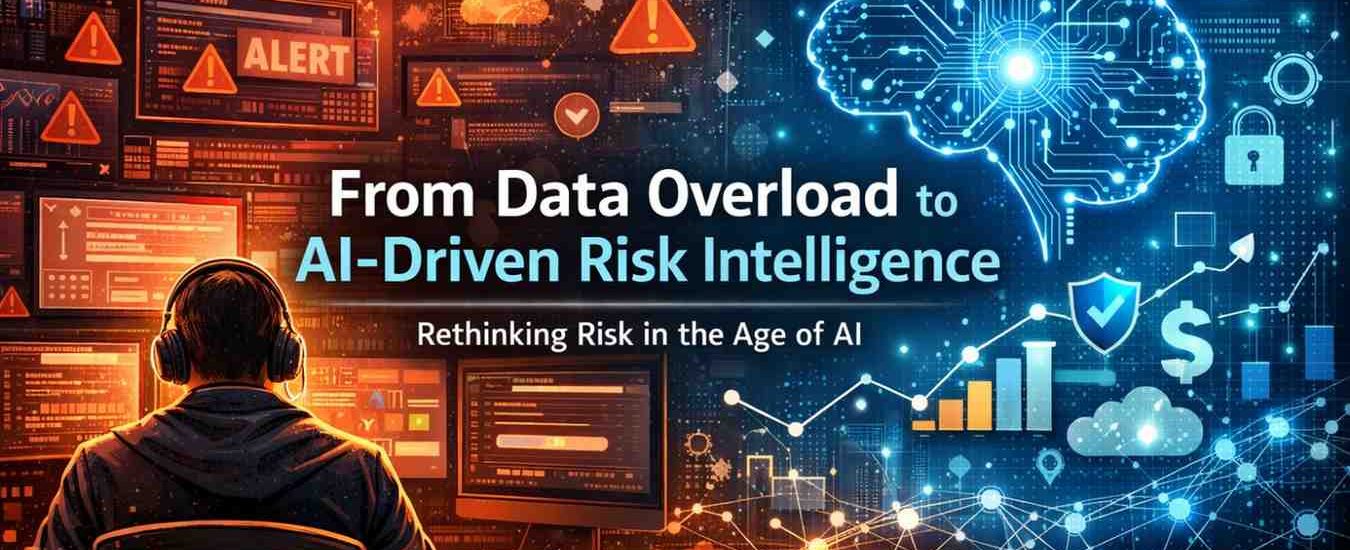
Modern Risk Management in an AI-Driven Threat Landscape
Security teams today don’t suffer from lack of visibility. They suffer from too much of it.
Every endpoint, firewall, SaaS platform, identity provider, and cloud workload generates telemetry. Organizations deploy platforms like Splunk, Microsoft Sentinel, and advanced detection tools from CrowdStrike to monitor their environments. The result? Millions of events, thousands of alerts, and endless dashboards.
Yet despite this ocean of data, one question remains difficult to answer:
What actually puts the business at risk right now?
The Illusion of Visibility
Digital transformation has dissolved traditional perimeters. Cloud adoption, remote work, APIs, DevOps pipelines, and SaaS ecosystems have expanded the attack surface exponentially. Each layer produces logs, anomalies, configuration alerts, and vulnerability findings.
The problem isn’t detection. It’s prioritization.
Security teams are flooded with:
Critical CVEs
Suspicious logins
Threat intelligence matches
Misconfigurations
Endpoint alerts
Individually, each looks urgent. Collectively, they become noise.
Tool sprawl makes it worse. SIEMs, EDRs, vulnerability scanners, IAM tools, and threat feeds operate in silos. A vulnerability scanner flags severity. An EDR flags behavior. A threat feed flags an IP. But rarely do these tools answer the business-centric question:
Is this exploitable in our environment, and does it materially increase enterprise risk?
Why Traditional Risk Models Break Down
Conventional risk frameworks rely on periodic assessments and static scoring models:
Risk = Likelihood × Impact
This worked in slower, perimeter-based IT environments. It fails in cloud-native, identity-driven ecosystems.
Three core problems stand out:
1. Static vs. Dynamic Reality
Risk registers are updated quarterly. Threat actors evolve daily. Ransomware campaigns, zero-day exploits, and AI-driven phishing don’t wait for annual reviews.
2. Subjective Scoring
“High,” “Medium,” and “Low” often reflect opinion more than evidence. Without real-time adversary data, likelihood becomes guesswork.
3. Severity ≠ Exploitability
A vulnerability rated 9.8 CVSS may not be reachable. Another rated 7.5 might provide a direct path to domain compromise. Traditional models rarely account for exposure paths, asset criticality, or identity relationships.
Frameworks from bodies like the National Institute of Standards and Technology and the International Organization for Standardization provide strong governance structures. But when implemented as compliance checklists rather than living intelligence systems, they fail to capture real-time exposure.
The result? Teams chase theoretical risk while attackers exploit contextual weaknesses.
The AI-Driven Shift: From Alerts to Context
AI-based risk management changes the equation. Instead of treating findings in isolation, modern systems ingest and correlate:
Asset inventories
Identity privileges
Vulnerability data
Threat intelligence
Behavioral telemetry
Risk becomes continuous and contextual.
Rather than asking, “Is this severe?” AI asks:
Is it exposed?
Is it being actively exploited?
Does it connect to privileged assets?
Does it create a viable attack path?
This is a fundamental shift—from static scoring to dynamic modeling.
Attack Paths Over Alert Counts
One of the most powerful advances is attack path analysis.
AI models identity relationships, privilege escalation chains, lateral movement routes, and cloud misconfigurations. Instead of patching thousands of vulnerabilities based solely on severity, teams can focus on the handful that create real compromise pathways.
Often, fixing five strategically positioned weaknesses reduces more risk than patching five hundred isolated issues.
That is intelligent prioritization.
Reducing Noise Through Behavioral Intelligence
Traditional rule-based alerts trigger on predefined conditions. AI introduces behavioral baselining.
A single anomalous login might be harmless. But an anomalous login followed by privilege escalation and abnormal data access forms a meaningful pattern.
AI connects these dots at machine speed. The outcome is fewer false positives, faster triage, and measurable reduction in Mean Time to Detect (MTTD) and Respond (MTTR).
Bridging Cyber Risk and Business Risk
The next evolution is business-aware risk quantification.
AI-driven platforms increasingly factor in:
Asset criticality
Revenue impact
Regulatory exposure
Data sensitivity
Executives no longer want to know how many alerts exist. They want to know:
What is our ransomware exposure probability?
What financial impact could a breach cause?
Which remediation actions most reduce enterprise risk?
AI helps translate technical findings into business language.
The Human + AI Model
AI does not replace security teams. It augments them.
It eliminates alert fatigue, automates correlation, and provides contextual prioritization. Analysts shift from reactive log review to strategic threat disruption. Risk managers move from static registers to continuous exposure oversight.
But AI requires strong foundations: accurate asset inventories, identity governance, reliable logging, and configuration visibility. Without clean data, intelligence degrades.
The Bottom Line
Security teams are drowning not because they lack tools—but because traditional risk models cannot scale to modern data velocity.
In today’s cloud-native, identity-centric, AI-accelerated threat landscape, risk management must be:
Continuous
Contextual
Intelligence-driven
Business-aligned
The future of cybersecurity will not be defined by how much telemetry we collect.
It will be defined by how effectively we convert that telemetry into actionable, measurable risk reduction.
From data overload to risk intelligence—that is the transformation underway.
Krishna Prasad is the Quality Manager at NABL IT Security’s ISO 17025-certified Security Testing Lab. He ensures that all security testing processes adhere to the highest quality standards and comply with global security regulations. With extensive experience in quality assurance, Krishna oversees the implementation of rigorous testing methodologies, guaranteeing that security assessments are both accurate and reliable.
Additionally, he manages asset tracking within the lab, ensuring that all security assets are effectively maintained, optimized, and up-to-date to support high-quality testing services. His dedication to quality and precision helps organizations enhance their security posture and meet compliance requirements in an increasingly complex cybersecurity landscape.