Enhancing Efficiency & Strengthening IT Security Posture with Agentic AI

IT Service Management (ITSM) plays a critical role in ensuring that IT services are delivered efficiently, consistently, and aligned with business needs. At the core of ITSM lies the IT ticketing and incident management process, which acts as a centralized mechanism for capturing, tracking, prioritizing, and resolving IT-related issues and service requests. Every user interaction—ranging from routine access requests to critical system outages—is logged as a structured ticket. This enables IT teams to manage workloads effectively, maintain accountability, and ensure timely resolution through standardized workflows. A well-structured ITSM framework ensures seamless communication between end users and IT teams. By providing a centralized platform, it enables users to raise requests easily while allowing IT teams to respond with clarity and transparency. This improves collaboration, reduces confusion, and enhances overall service delivery.
Operational Efficiency & Workflow Optimization
A well-implemented ITSM ticketing system significantly enhances operational efficiency by:
Automating ticket creation, categorization, and assignment
Defining priority levels based on impact and urgency
Enabling SLA (Service Level Agreement) tracking and compliance
Reducing manual intervention through predefined workflows
Eliminating duplicate or overlooked requests
These capabilities help organizations minimize downtime, optimize resource utilization, and improve overall productivity. Faster resolution times lead to increased end-user satisfaction and stronger service reliability.
Incident, Problem & Change Management Integration
Modern ITSM frameworks go beyond basic ticketing by integrating key processes such as:
Incident Management
Focuses on restoring normal service operations as quickly as possible with minimal business impact.
Problem Management
Identifies root causes of recurring incidents and implements long-term solutions to prevent future disruptions.
Change Management
Ensures that any changes to IT systems are planned, tested, approved, and implemented with minimal risk.
Together, these processes create a structured and proactive IT environment that reduces unplanned outages and enhances service stability.
Security & Compliance Enhancement
A mature ITSM system strengthens an organization’s cybersecurity posture by incorporating security incident handling into the ticketing workflow. Events such as phishing attempts, malware infections, or unauthorized access are logged, tracked, and resolved systematically.
Key benefits include:
Rapid detection and response to security incidents
Detailed audit trails for compliance and forensic analysis
Identification of recurring vulnerabilities through historical data
Alignment with standards such as ISO 27001, ITIL, and regulatory requirements
This structured approach ensures that security is not reactive but integrated into daily IT operations.
Integration with IT & Security Ecosystem
Modern ITSM platforms seamlessly integrate with various enterprise tools, including:
SIEM (Security Information and Event Management) systems
Endpoint protection and antivirus solutions
Monitoring and alerting tools
Asset and configuration management databases (CMDB)
These integrations enable real-time data sharing, automated incident creation, and faster response mechanisms—transforming IT operations into a proactive and intelligent ecosystem.
Data-Driven Insights & Continuous Improvement
ITSM tools provide powerful analytics and reporting capabilities that help organizations:
Track performance metrics (SLA compliance, resolution time, ticket volume)
Identify trends and recurring issues
Improve decision-making through actionable insights
Continuously optimize IT processes
This data-driven approach ensures continuous service improvement and long-term operational excellence.
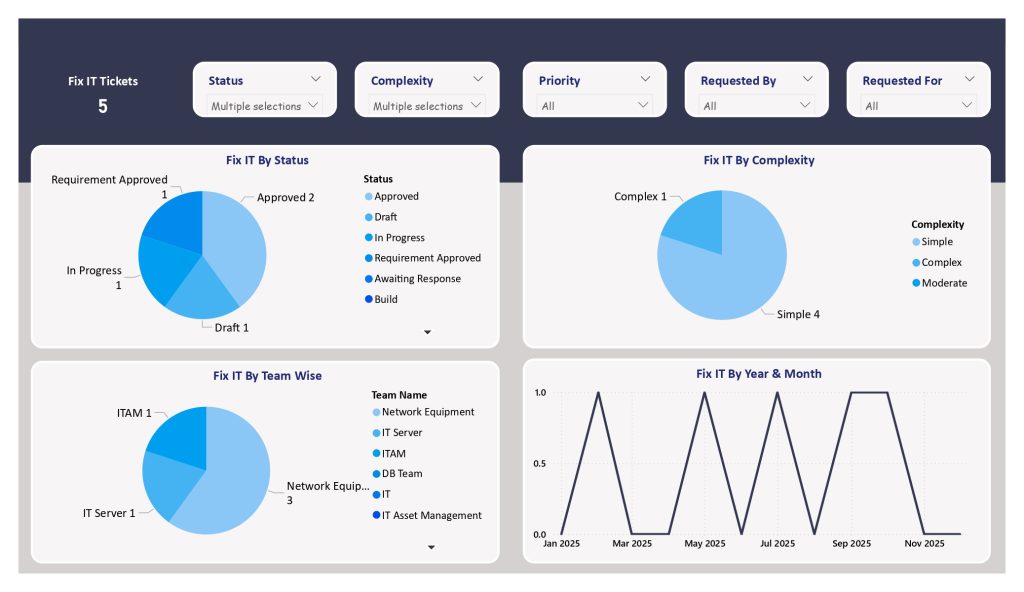
Fix IT Dashboard
Dashboard Insights
- Fix IT by Status: Displays the lifecycle of IT fix tickets, from Draft to Approved, showing the overall progress of internal resolutions.
- Fix IT by Complexity: Categorizes fixes as Simple, Moderate, or Complex to estimate resource effort and response efficiency.
- Fix IT by Team: Identifies which team (Network, Server, ITAM, etc.) is handling most fixes to monitor workload distribution.
- Fix IT by Year & Month: Provides a time-based view of fixes logged and resolved, highlighting productivity and recurring issues.
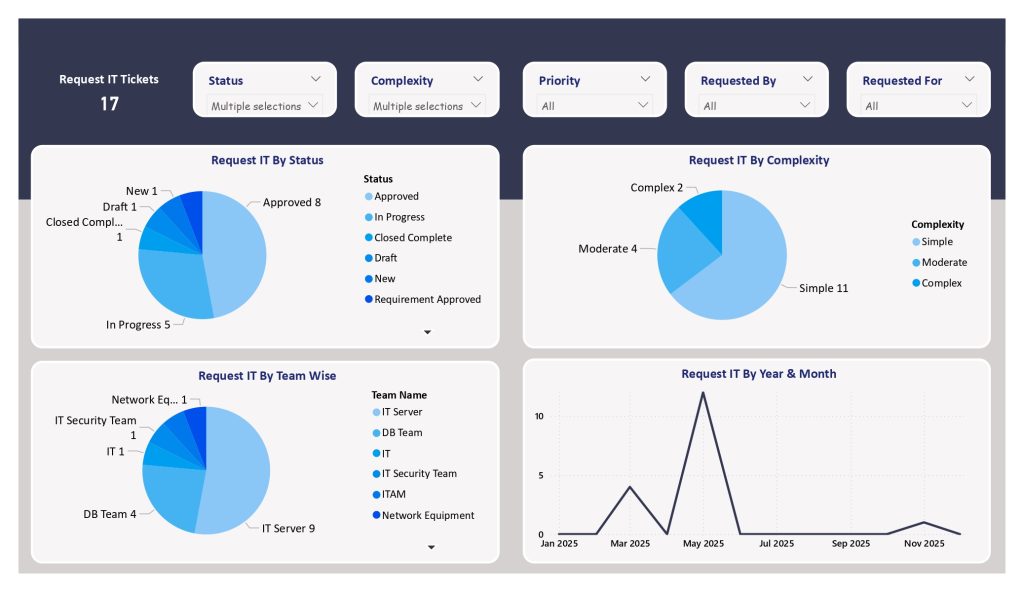
Request IT Dashboard
Dashboard Insights
- Request IT by Status: Visualizes ticket flow through statuses like New, Draft, In Progress, and Approved for efficient tracking.
- Request IT by Complexity: Groups incoming requests by complexity (Simple, Moderate, Complex) for prioritization.
- Request IT by Team: Displays which IT or support teams are handling most requests to manage workload balance.
- Request IT by Year & Month: Tracks trends in IT requests across months and years, helping forecast future demands.